
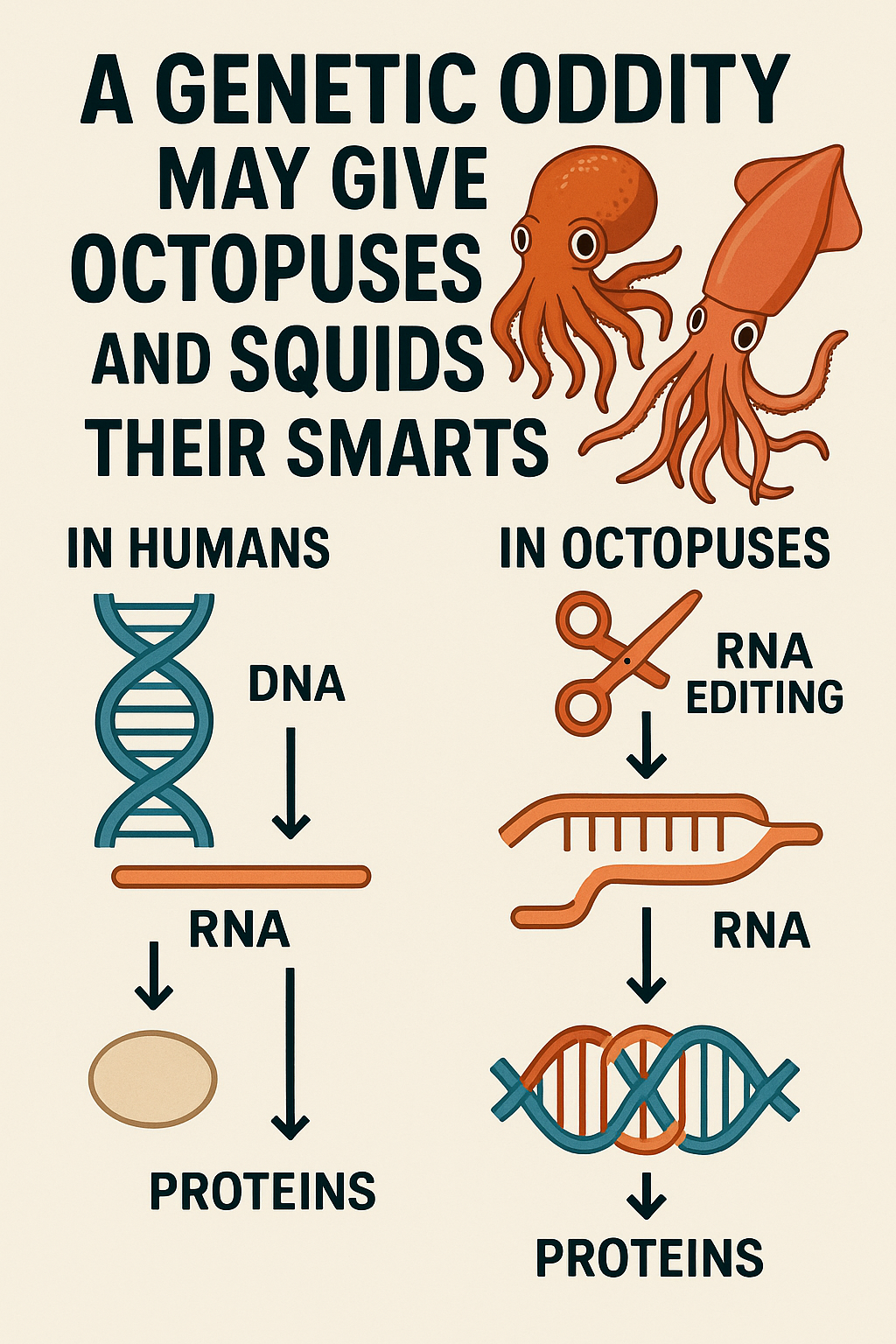
A Genetic Oddity May Give Octopuses and Squids Their Smarts
Octopuses and squids have long fascinated scientists and ocean enthusiasts alike. With their remarkable intelligence, problem-solving skills, and almost alien appearance, these cephalopods often seem like creatures from another world. Recent research has revealed a genetic twist that may help explain their extraordinary cognitive abilities—one that sets them apart from nearly every other animal on Earth.
The Mystery of Cephalopod Intelligence
Octopuses and squids are famously clever. They can:
- Solve puzzles and escape enclosures.
- Camouflage themselves instantly by changing color and texture.
- Use tools, like coconut shells, for protection.
- Exhibit complex social behaviors and even playful curiosity.
These abilities rival the intelligence of some mammals, despite the fact that octopuses and squids are invertebrates. This raised a big question for scientists: What makes their brains so unique?
RNA Editing: A Genetic Oddity
The answer may lie in a rare process called RNA editing.
In most animals, genetic instructions flow in a predictable path:
DNA → RNA → Proteins
However, cephalopods break the rules. Instead of following their DNA exactly, they edit their RNA on the fly, allowing them to produce proteins that aren’t directly encoded by their genes.
Why This Matters:
- RNA editing gives octopuses and squids flexibility in how their nervous systems function.
- It may help them adapt quickly to changes in their environment.
- This process could be key to their advanced learning, memory, and behavior.
A 2023 study found that over 60% of their RNA transcripts can be edited—an astonishing figure compared to humans, who edit only a tiny fraction.
A Brain Unlike Any Other
Octopus and squid brains are structured very differently from vertebrate brains:
- Their neurons are spread throughout their arms, giving each limb a degree of independence.
- Some researchers liken their nervous systems to multiple mini-brains working together.
- This decentralized system, combined with RNA editing, allows for incredible adaptability.
For example, if water temperatures shift, RNA editing could rapidly tweak neural proteins to maintain optimal function—like reprogramming a computer without changing its hardware.
Implications for Evolution
This discovery challenges traditional ideas about how intelligence evolves:
- In mammals, intelligence is tied to DNA changes over long periods of time.
- In cephalopods, intelligence might evolve in real time through RNA editing.
Some scientists even speculate that this unique mechanism could explain why octopuses and squids seem so alien compared to other life forms.
Why It Matters to Humans
Understanding cephalopod RNA editing isn’t just about solving a scientific mystery—it has potential applications for humans:
- Medical breakthroughs: Insights into RNA editing could lead to new treatments for neurological disorders.
- AI and robotics: Studying how octopuses process information could inspire new designs for flexible, adaptive systems.
- Climate change resilience: Learning how cephalopods adapt at a molecular level may help scientists predict how marine life will cope with environmental shifts.
Final Thoughts
The ocean’s most enigmatic creatures are teaching us that intelligence can take many forms. Through their unusual genetic toolkit, octopuses and squids remind us that evolution is endlessly creative, and that there’s still so much we don’t understand about the minds of other animals—or even our own.
As scientists continue to explore the secrets of RNA editing, one thing is clear: the brains of these tentacled geniuses hold clues to some of the deepest questions about life, adaptation, and intelligence


I don’t think the title of your article matches the content lol. Just kidding, mainly because I had some doubts after reading the article.
Can you be more specific about the content of your article? After reading it, I still have some doubts. Hope you can help me. https://www.binance.com/fr-AF/register?ref=JHQQKNKN