
After Badger Buries Entire Cow Carcass, Scientists Go to the Tape
Nature is full of surprising behaviors, but even experienced wildlife scientists weren’t prepared for what they discovered in the Utah desert. When researchers left a cow carcass in the wild as part of a scavenger study, they expected vultures, coyotes, or other large predators to take interest. Instead, a single badger shocked the scientific community by doing something almost unbelievable: burying the entire cow carcass by itself.
The Unexpected Discovery
The team of researchers from the University of Utah had set up cameras to study scavenger behavior. Their goal was to understand how different animals interacted with large carrion, like dead cattle.
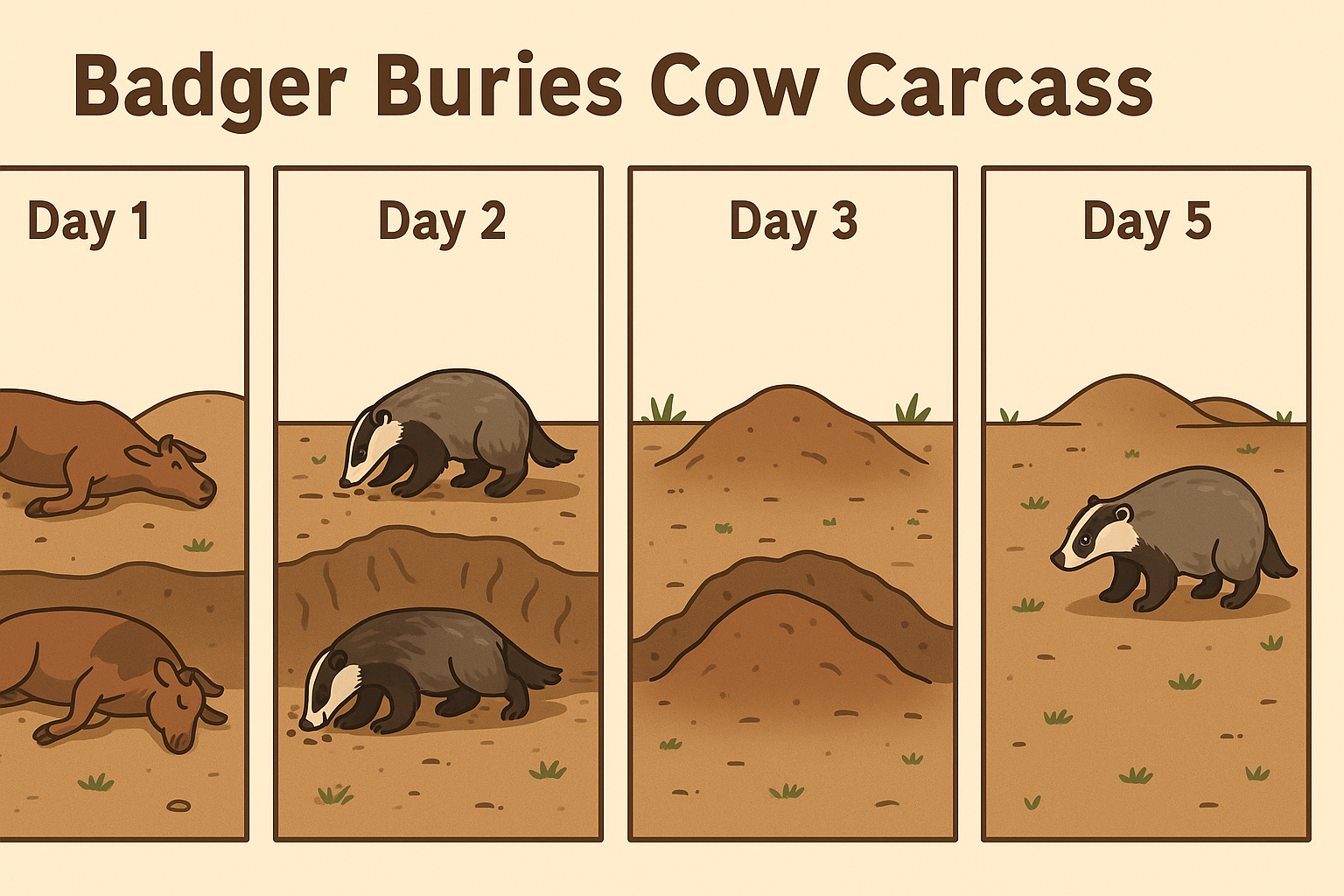
To their surprise, when they reviewed the footage, they saw a badger working relentlessly for five straight days, digging and pushing dirt to completely cover a cow carcass weighing several times more than itself.
“We couldn’t believe what we were seeing,” said lead researcher Ethan Frehner.
“Badgers are known to bury smaller prey like rabbits, but a cow? That was completely unprecedented.”
Why Would a Badger Do This?
Badgers are solitary carnivores and skilled diggers. Normally, they hunt small mammals and cache them underground to save for later. But a cow carcass is far beyond their usual scale.
Researchers believe the badger’s actions were a form of food hoarding:
- By burying the carcass, the badger protected it from other scavengers like vultures or coyotes.
- The buried meat stays cool and preserved underground, providing a long-term food source.
- This behavior may give badgers an advantage during scarce winter months.
This is similar to how squirrels store nuts for winter, except on a much larger—and more dramatic—scale.
The Power of Camera Traps
Without the motion-sensing cameras, this remarkable event would have gone completely unnoticed. The footage provided:
- A day-by-day record of the badger’s digging process.
- Evidence of previously unknown badger behavior.
- Insights into the ecological role of smaller scavengers, showing they can compete with larger predators in unexpected ways.
This discovery highlights the value of wildlife monitoring technology in revealing the hidden lives of animals.
Implications for Ecology
The badger’s feat isn’t just a quirky natural phenomenon—it has important ecological implications:
- Carcass decomposition: By burying the cow, the badger influenced how nutrients returned to the soil and how other scavengers accessed the resource.
- Competition dynamics: This shows that even small predators can outsmart larger ones through strategy, not just strength.
- Conservation insights: Understanding scavenger behavior helps scientists manage ecosystems and livestock management practices.
Why This Story Captured the Public’s Imagination
The image of a small, determined badger single-handedly burying an entire cow struck a chord with people worldwide. It’s a story of:
- Persistence: The badger worked tirelessly for nearly a week, driven by instinct and survival.
- Surprise: It challenges our assumptions about what small animals are capable of.
- Curiosity: It reminds us that there are still mysteries in the natural world waiting to be discovered.
The video went viral, proving that sometimes science and storytelling go hand-in-hand.
Final Thoughts
This extraordinary event is a powerful reminder of nature’s ingenuity and resilience. From a scientific perspective, it opens new questions about animal behavior and ecosystem dynamics. From a human perspective, it inspires awe and curiosity.
As researchers continue to “go to the tape” and review footage from wildlife studies, who knows what other secrets are waiting to be unearthed—perhaps by another unexpected hero, like the humble badger.

I don’t think the title of your article matches the content lol. Just kidding, mainly because I had some doubts after reading the article. https://www.binance.com/register?ref=IHJUI7TF